
As an Amazon Associate, we earn from qualifying purchases. Buying through our links costs you nothing extra.
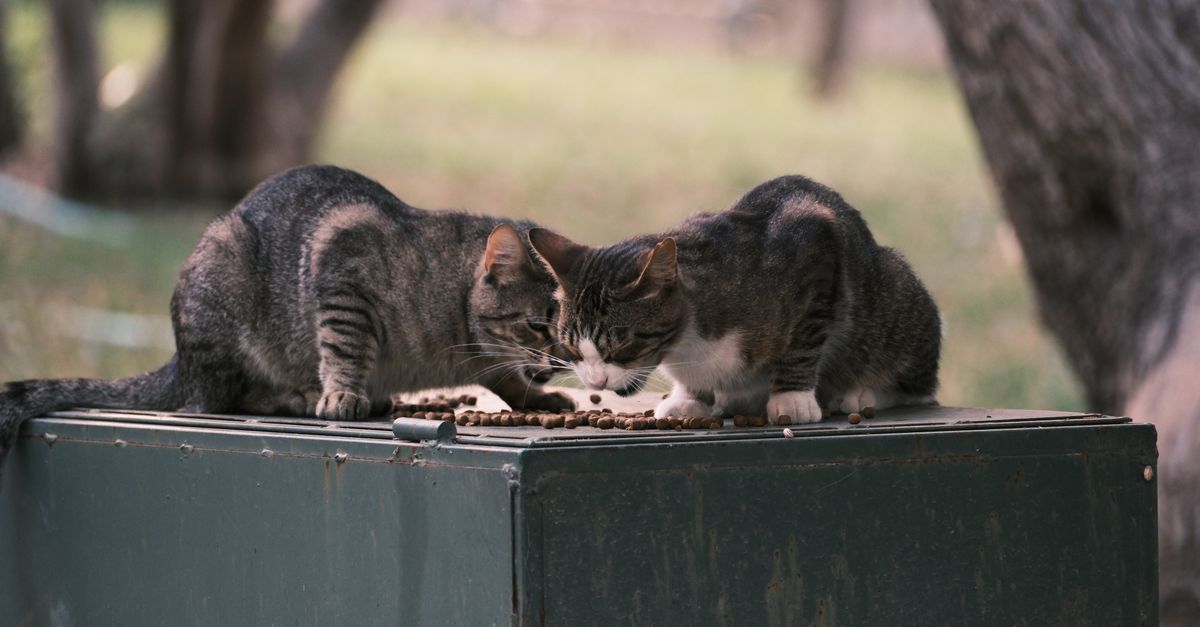
A cat eating other cat’s food is a common mealtime problem in multi-cat homes. Start by working out why it happens, then pick the fix that suits your cats: separate rooms, scheduled meals, or a feeder that opens only for the right cat.
Quick pick: PETLIBRO RFID Multiple Cats Feeder (2-pack)
Best for two cats on different dry diets: each feeder opens only for the cat wearing its paired collar tag.
Quick fixes
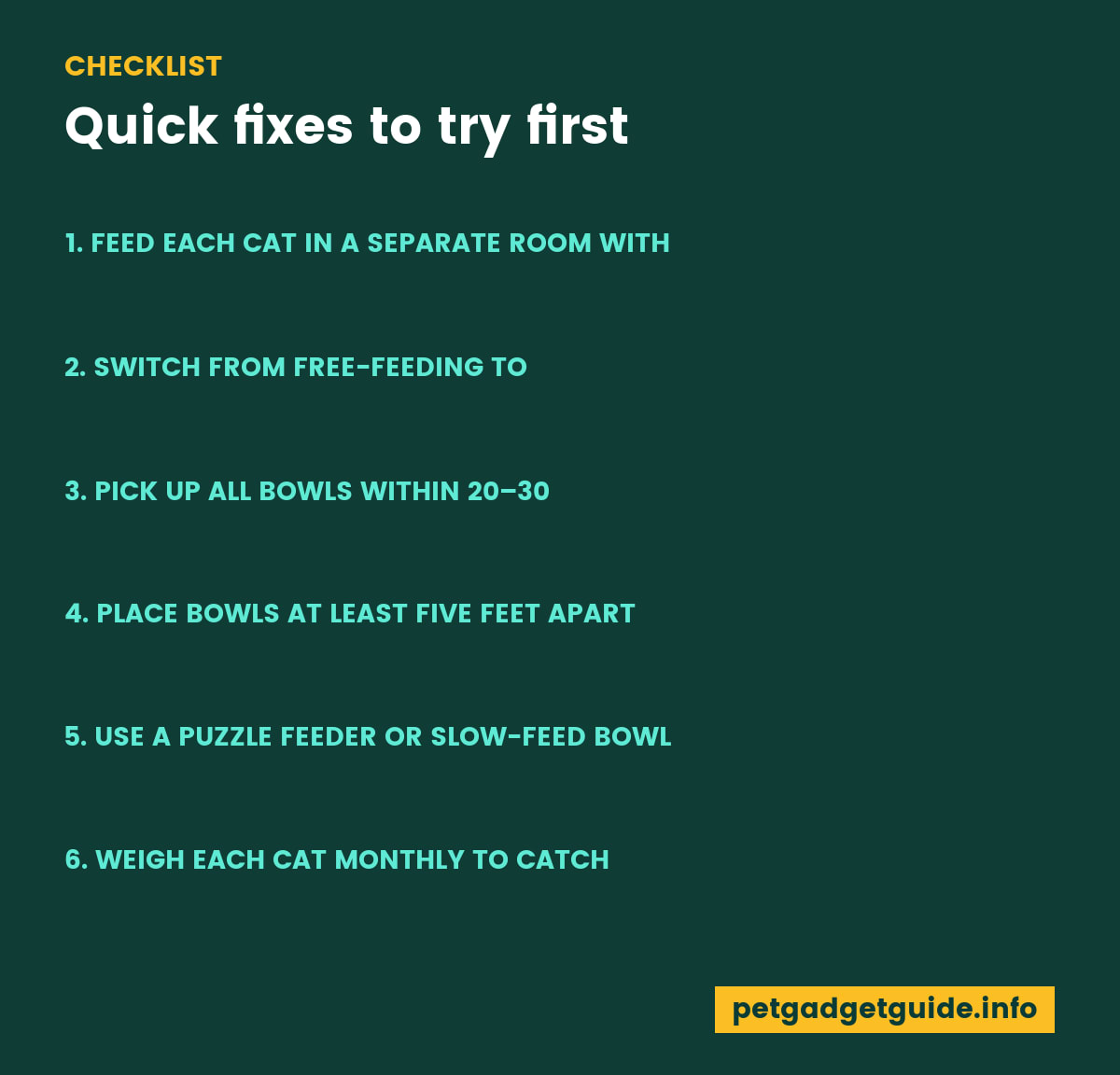
- Feed each cat in its own room with the door closed, at least until the stealing stops.
- Switch from free-feeding to measured meals at set times, spread through the day.
- Take away leftovers when mealtime is over instead of leaving bowls down.
- If separate rooms are not possible, set bowls as far apart as you practically can, out of each other’s line of sight.
- Give the fast eater a puzzle feeder or slow-feed bowl so the slower cat has time to finish.
- Weigh each cat every few weeks so you spot gains or losses early.
Why it happens
Hardwired opportunistic eating
Cats evolved as hunters that eat whenever food turns up, and a reliable food bowl at home does not switch that instinct off. A cat that has emptied its own dish and finds another one still full is not being greedy in a human sense. It is doing what its instincts tell it to do.
Social hierarchy at the bowl
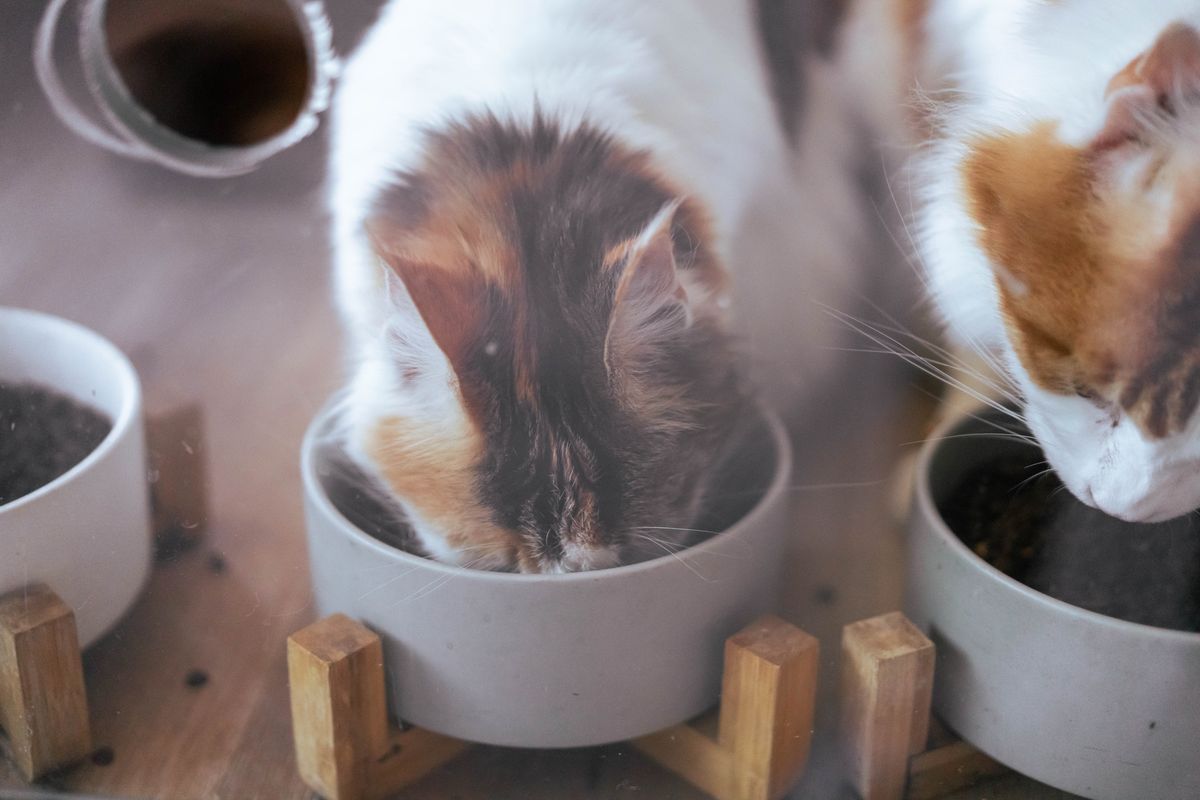
In many multi-cat homes, the cat that steals is simply the more confident one. There may be no hissing or fighting at all: the bolder cat sits near the other bowl, stares, or moves in as soon as the other cat steps back. The cat being pushed out can look as if it has finished eating when it has really given up. The Feline Veterinary Medical Association’s guide to feeding cats warns that cats often eat side by side without showing obvious distress, even when group feeding is causing stress, gorging or food aggression.
Stress and insecurity
Changes in the household, such as a new cat, a move or a new routine, can make a cat less sure that food will keep coming, and some cats respond by eating whatever they can reach. If you recently added a cat, our guide on introducing a new cat to your home covers how to slow things down.
Free-feeding makes it worse
When food sits out all day, there is never a clear end to mealtime. The bolder cat can graze from every bowl, and you cannot tell who ate what. PetMD’s veterinary guide to feeding cats separately lists free-feeding as a common cause of overeating and food stealing.
Learned habit
The longer the stealing goes on, the more it becomes routine: the cat learns that finishing fast and then checking the other bowl pays off. A one-off change rarely breaks it. What works is the same routine at every meal, every day.
How to stop a cat eating other cat’s food, step by step
Step 1 — Switch to scheduled meals.
Measured meals at set times put you back in control of who eats what. PetMD’s vets advise that adult cats should not go much more than eight hours between meals, and the FelineVMA recommends splitting the daily ration into several small meals, which is closer to how cats naturally eat. Measure each cat’s portion, put all the bowls down at the same time, and ask your vet how much each cat should be eating.
Step 2 — Feed in separate rooms.
For stealing that keeps happening, a closed door is the simplest barrier. Put each cat’s bowl in a different room, such as a bathroom, bedroom or home office, and keep the doors shut until both cats have finished. As PetMD’s vet guide points out, a microchip feeder controls which cat reaches the food, but it cannot stop a bossy cat from hovering nearby and making the other one too nervous to eat, so a separate room still matters for cats that intimidate each other.
Step 3 — Take the bowls up after meals.
Scheduled meals only work if leftovers do not stay down for the faster cat to finish later. Give the cats a reasonable window (many owners use about 20 to 30 minutes), then pick up every bowl, empty or not. If one cat regularly leaves food, mention it to your vet; it may do better with smaller, more frequent meals than with a shorter window.
Step 4 — Space the bowls apart and out of sight.
If separate rooms are not an option, put the bowls in different parts of the room, with something between them so the cats cannot see each other while they eat. A cat tree, a cardboard box or a piece of furniture is enough. Distance plus a visual barrier between feeding stations is what the FelineVMA recommends for multi-cat homes.
Step 5 — Slow down the fast eater.
If one cat finishes in a minute and then heads for the other bowl, make its meal take longer. A puzzle feeder, a slow-feed bowl or a lick mat for wet food all work. A simple homemade version is a small bowl turned upside down inside a larger one, so the cat has to eat around it. Start with an easy puzzle so the cat does not give up.
Step 6 — Use height.
If one cat climbs easily and the other does not (an older or heavier cat, for example), feed the agile cat on a counter, a stable shelf or the top of a sturdy cat tree, where the other cat cannot follow. This works best when the cat that cannot climb is the one doing the stealing.
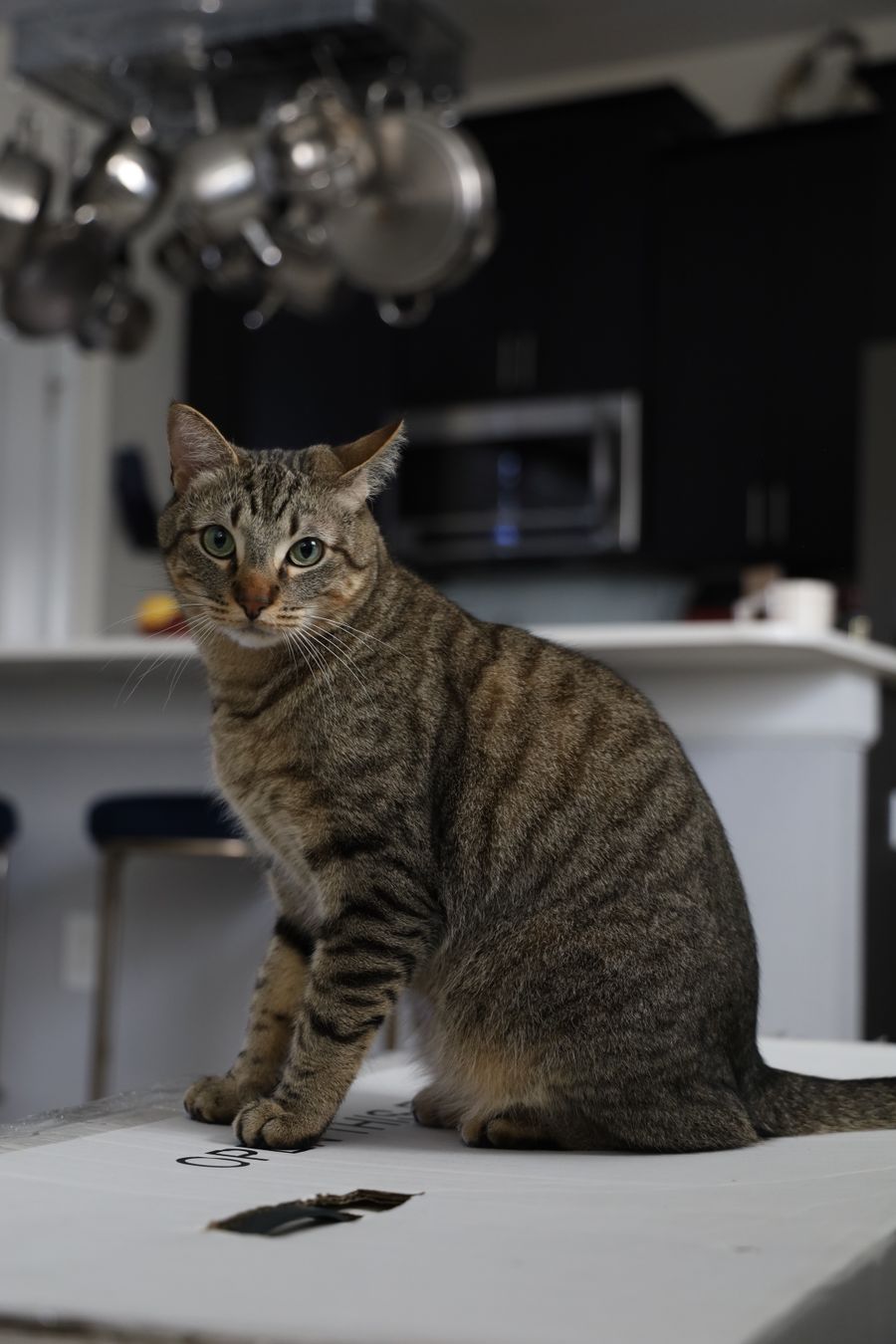
Step 7 — Add a selective feeder if the problem continues.
When you cannot supervise meals, during a workday for example, a microchip or RFID feeder lets only the registered cat open the bowl. The three options below each solve a slightly different problem. For a wider comparison, see our guide to the best automatic cat feeders for multiple cats.
Gadgets that help
Best for two cats on different dry diets: PETLIBRO RFID Multiple Cats Feeder (2-pack)
This bundle pairs two PETLIBRO RFID feeders, each linked to its own collar tag. A feeder opens its lid only when the matching cat walks up and closes again for any other cat, so two cats on different dry foods can each eat from their own machine. Meal times, portions and feeding logs are managed in the PETLIBRO app.
According to the listing, each unit holds 3 L of kibble and connects over 2.4 GHz or 5 GHz Wi-Fi. It works with the included collar tags, not your cat’s implanted microchip, and the base and tag reader must be kept dry.
Skip it if: either cat refuses to wear a collar, or one of them eats wet food; this feeder is designed for dry kibble.
Check the current price on Amazon
Best for wet food or a cat that won’t wear a collar: Sure Petcare SureFeed Microchip Pet Feeder
The SureFeed reads the microchip your cat already has (9-, 10- and 15-digit chips, according to the listing) or the collar tag that comes in the box, and opens its lid only for registered pets. If another cat pushes in, the lid stays shut or closes. It takes one portion of wet or dry food, which makes it one of the few selective feeders that suits wet food. It runs on batteries and does not dispense food on a schedule: you fill the bowl yourself at mealtime.
Skip it if: you want automatic, scheduled portions while you are away, or your cat is too large to eat comfortably under the hood. Each unit serves one bowl, so protecting two cats’ diets means two feeders.
Check the current price on Amazon
Best for one cat’s scheduled dry meals: PETLIBRO RFID Automatic Cat Feeder (single)
The single PETLIBRO unit pairs with one collar tag and opens only for that cat, so it suits a home where just one cat needs a special or measured diet and the others eat elsewhere. It dispenses the dry-food portions you schedule in the app and logs each feeding. According to the listing, it holds 3 L and supports 2.4 GHz and 5 GHz Wi-Fi.
It does not read implanted microchips, only PETLIBRO’s own tag, and the tag is splash-resistant rather than waterproof.
Skip it if: more than one cat needs a protected diet (the 2-pack above is simpler), or your cat will not tolerate a collar.
Check the current price on Amazon
When to see a vet
Food stealing is usually behavioral, but a cat whose appetite suddenly jumps may be ill. Call your veterinarian if you notice any of the following.
Eating more but losing weight. The Cornell Feline Health Center lists weight loss, a bigger appetite, and increased thirst and urination as the most common signs of hyperthyroidism, a disease that mostly affects middle-aged and older cats.
Drinking more and leaving bigger litter-box clumps. According to Cornell, weight loss despite a good appetite, together with increased thirst and urination, are the signs of diabetes owners most often notice at home.
A big appetite with loose stools or vomiting. Some intestinal diseases stop food from being absorbed properly, so a cat can eat more and still lose condition. Your vet can run the tests to find out.
Any sudden change in appetite, up or down. A change in appetite is an early sign of many illnesses, which is one more reason to feed cats separately: you see straight away who is eating what. If a cat is eating less while you are out, see our guide to a cat not eating when you’re away.
The cat losing out is getting thinner. Weight loss in cats is easy to miss by eye, especially under a thick coat. Weigh each cat every three to four weeks (step on a bathroom scale holding the cat, then subtract your own weight) and show your vet any downward trend.
Safety note: keep the power cords of electric feeders out of reach of cats that chew, and use feeders indoors. For weight loss, changes in thirst or digestive upsets, see your vet rather than adjusting portions on your own.
How We Researched This
We did not test these feeders in person. To work out what stops a cat eating other cat’s food, we compared the manufacturers’ specs and manuals, owner discussions outside Amazon, and similar products. Our method.
FAQ
How do I stop one cat eating other cat’s food when I am not home?
Two setups work without supervision: shutting each cat in its own room with its food before you leave, or a microchip or RFID feeder that opens only for the registered cat. If the cats are on different diets, a selective feeder is the more dependable option, because it does not rely on doors staying shut all day.
Is free-feeding safe in a multi-cat home?
Usually not. Food left out all day lets the boldest cat eat the most, and you cannot see how much each cat eats, which also hides the early appetite changes that can point to illness. Measured meals at separate stations avoid both problems.
Will feeding cats in the same room work if the bowls are far apart?
Sometimes. It helps most with cats that guard quietly, as long as the bowls are well apart and out of each other’s line of sight. A determined stealer will usually just walk over once its own bowl is empty, so for those cats, separate rooms or a selective feeder work better.
Do RFID feeders read my cat’s implanted microchip?
Not the PETLIBRO feeders: they work only with PETLIBRO’s own collar tag. The SureFeed Microchip Pet Feeder reads most implanted microchips as well as its own collar tag, so it is the better choice for a cat that will not wear a collar.
My cat eats fast and then steals. Can I fix that without a gadget?
Yes. Make its meal take longer with a puzzle feeder or a homemade slow bowl (a small bowl turned upside down inside a larger one), keep the cats apart while they eat, and take the bowls up once mealtime is over.
What if one cat needs a prescription diet and the other does not?
This is where stealing does the most harm. A prescription diet only works if the cat eats that food and nothing else, and the other cat usually does not need it. Feed the cats in separate rooms, or give each one a selective feeder keyed to it, and ask your vet how strict the separation needs to be.
If tension between your cats goes beyond mealtime, our guide to pets fighting at home covers the bigger picture.
Sources
- Cornell Feline Health Center — Hyperthyroidism in Cats
- Cornell Feline Health Center — Feline Diabetes
- Feline Veterinary Medical Association — How to Feed a Cat: Addressing Behavioral Needs
Product listings and links checked October 23, 2026.
The Smart Cat Owner’s Gadget Checklist
20 gadgets worth owning, 8 to skip, and how to choose the right one — sent straight to your inbox.