
As an Amazon Associate, we earn from qualifying purchases. This post contains affiliate links; buying through them costs you nothing extra.
The best automatic cat feeders for multiple cats solve a social problem first: one cat rushing another cat’s bowl. The feeder type that fits your household depends on whether your problem is timing, food theft, or diet separation.
Quick picks: the 3 feeders most multi-cat homes should start with
- Best overall for 2 cats
oneisall Dual-Bowl Feeder
Drops measured portions into two separate bowls at the same time, so the faster cat cannot clear both.
- Best when one cat steals food
SureFeed Microchip Feeder
The lid opens only for the cat whose microchip it recognizes, so a diet or senior cat eats undisturbed.
- Best no-power option
Gardner Pet Gravity Set
No timer, batteries or app: a simple food-and-water station for cats that graze through the day.
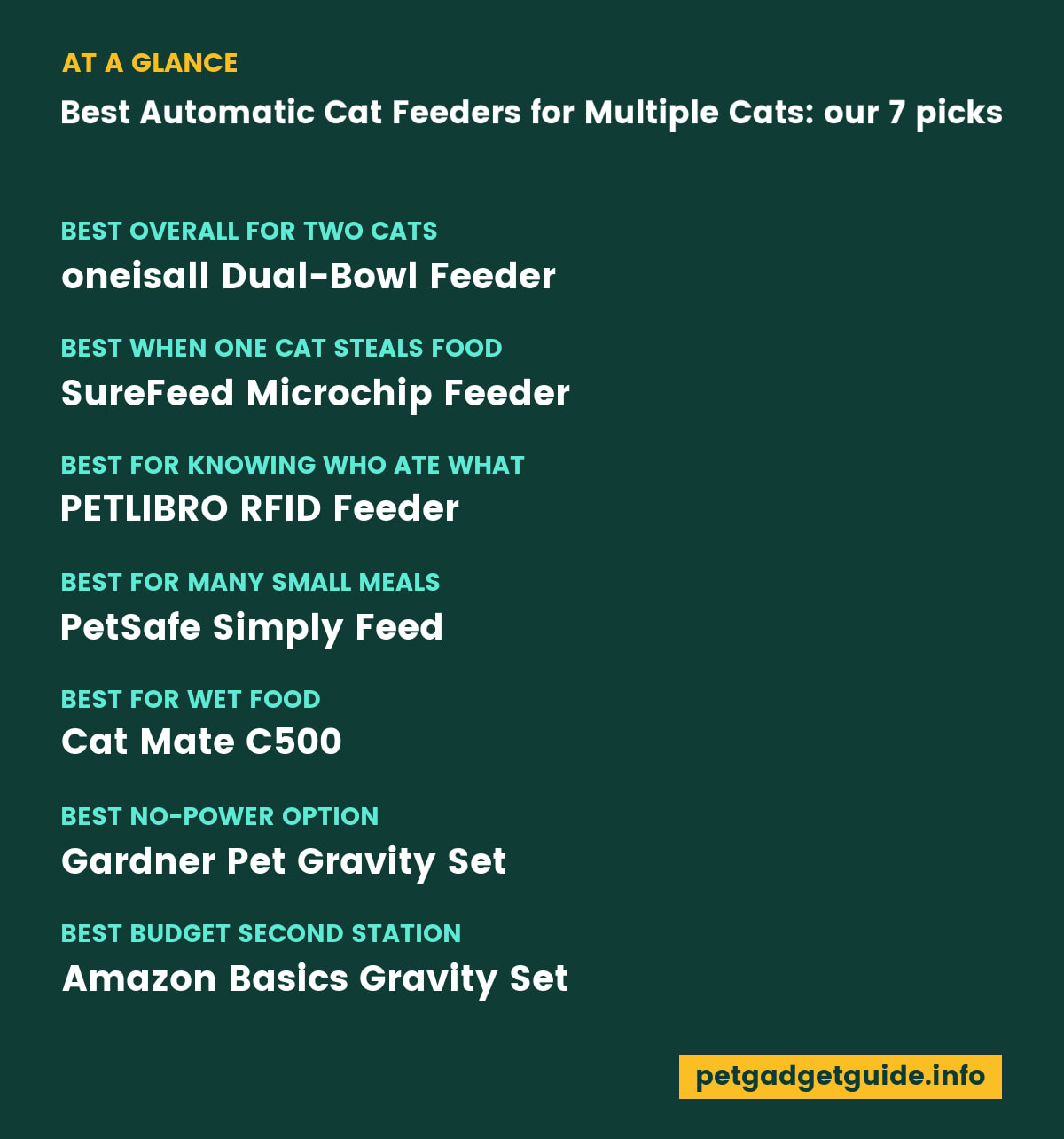
Best Automatic Cat Feeders for Multiple Cats at a Glance
| Feeder | Type | Best for | Where to buy |
|---|---|---|---|
| oneisall Dual-Bowl | Timed, two bowls | Two cats fed at the same time, apart | Check on Amazon |
| SureFeed Microchip Feeder | Microchip-selective | One cat stealing the other cat food | Check on Amazon |
| PETLIBRO RFID Feeder | Collar-tag selective | Knowing exactly who ate what | Check on Amazon |
| PetSafe Simply Feed | Timed, large hopper | Many small meals across a long day | Check on Amazon |
| Cat Mate C500 | Chilled tray feeder | Households feeding wet food | Check on Amazon |
| Gardner Pet Gravity Set | Gravity, no power | Grazers, and a second station | Check on Amazon |
| Amazon Basics Gravity Set | Gravity, no power | Matching food and water in one | Check on Amazon |
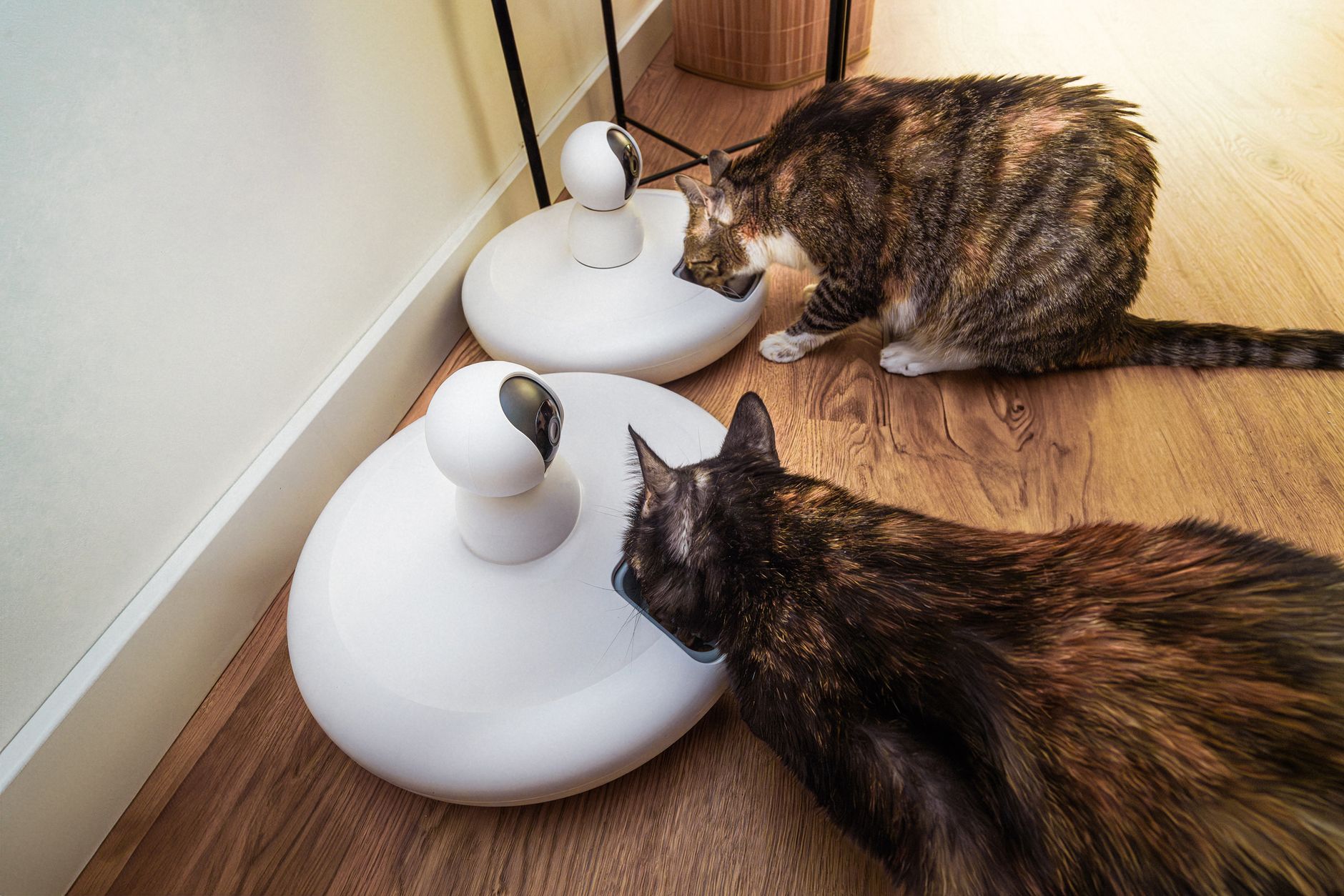
1. oneisall Dual-Bowl Feeder: Best Overall for Two Cats
Best for: Two cats who need equal portions dispensed at the same moment
For most two-cat homes this is the simplest place to start. A single hopper splits into two chutes and drops measured portions into two separate bowls at the same moment, which removes the race entirely. Both cats start eating at once, in two places, with the same amount in front of each. The hopper holds enough for several days of scheduled meals, so the fast eater cannot finish the week in an afternoon.
The limit is in the name: it is built for two. Three cats means either two units or one cat waiting. It also portions dry food only. See the oneisall dual-bowl on Amazon.
oneisall Dual-Bowl Feeder — best for two cats fed at the same time, in separate bowls.
What owners and reviewers report
From owner discussions and independent reviews outside Amazon.
- Fair split for two cats. An owner of this two-bowl model says it fills both bowls at the same time, so each cat gets its share. (Slickdeals forum)
- No Wi-Fi, clunky first setup. The same owner confirms there is no Wi-Fi and found the on-unit setup screens awkward the first time. (Slickdeals forum)
- Battery backup earns its place. The owner found the battery backup useful. (Slickdeals forum)
- Helps with food-aggressive cats, with tweaks. Another owner who has used it for one to two years says it helps keep food-aggressive cats apart, but they taped the bowls down and anchored the unit to furniture. (Slickdeals forum)
2. SureFeed Microchip Feeder: Best When One Cat Steals Food
Best for: Households where one cat steals or guards the other cat’s food
If your actual problem is a bully rather than a schedule, this is the category that solves it and the others do not. The lid opens only for the cat whose microchip or collar tag it recognizes, and closes again when that cat walks away. The thief can sit next to it for an hour and get nothing.
That makes it the right answer for the two hardest multi-cat situations: a cat on prescription or weight-control food that the other must not touch, and a senior cat who eats slowly and keeps getting pushed off. You need one unit per cat that needs protecting, and it is a tray feeder rather than a hopper, so it holds a meal rather than a week. See the SureFeed microchip feeder on Amazon.
SureFeed Microchip Feeder — best when one cat keeps stealing the other cat’s food.
What owners and reviewers report
- Prescription-diet separation works as intended. Because the lid opens only for the registered pet’s microchip, the feeder is a practical way to keep a restricted or veterinary diet away from other pets in the home.
- Setup is fast for microchipped pets. In learning mode the feeder reads the cat’s existing microchip as it eats, so there is no chip number to type in.
- The motor noise can slow adoption for timid cats. The motor does make a brief noise, so a skittish pet might take a few days to get used to it. The built-in training mode exists for exactly this, so work through its stages rather than skipping straight to normal operation.
- The open-back design is a known vulnerability. The open-back design can be a vulnerability, as determined pets may try to sneak food from behind. Sure Petcare offers a rear cover accessory to address this, but it is sold separately.
- Some units develop lid-motor issues over time. If the lid starts to struggle or the motor sounds strained, try fresh batteries first, then contact Sure Petcare support if the problem continues.
If you are considering other RFID-style feeders, our RFID Cat Feeder Review: PETLIBRO’s Honest Pros and Catches covers a competing option in the same category.
For persistent eating or behavior problems related to stress at mealtimes, consult a veterinarian or certified animal behaviorist.
3. PETLIBRO RFID Feeder: Best for Knowing Who Ate What
Same selective idea, different trade-off. A collar tag unlocks the feeder for a specific cat, and the app logs each visit, so at the end of the week you can see that one cat ate every scheduled meal and the other skipped two. In a multi-cat house that log is often the first hard evidence that something has changed, because a cat going quietly off its food is very easy to miss when there are two bowls and two cats.
It depends on the cat wearing the tag and on your Wi-Fi staying up, and it is a more complicated object than most cats need. If nobody in the house is stealing food and nobody is unwell, this is more feeder than you have to buy. See the PETLIBRO RFID feeder on Amazon.
PETLIBRO RFID Feeder — best when you need to know exactly who ate what.
What owners and reviewers report
- Diet separation working as intended in prescription-diet situations: Owners managing cats on separate therapeutic diets — including a low-iodine thyroid diet — report the RFID system preventing cross-feeding in day-to-day use (Podfeet Podcasts)
- Collar dependency is the top friction point: The main limitation is that the RFID cat feeder reads only the proprietary collar tag; cats that remove or lose collars defeat the access control entirely.
- Kibble shape affects dispensing reliability: There are differences in how smoothly food is dispensed based on the shape and size of kibbles; the RFID cat feeder works well with small, round kibble but flat and X-shaped kibbles sometimes back up in the chute.
- Lid noise during meals: The accordion door contacts the back of the cat’s head and slides along its rails as the cat moves forward, so the door can squeak during meals.
- Open bowl can be accessed by a second cat mid-meal: While the RFID cat feeder opens with the correct RFID tag, there is no setting that will close it if it detects a different tag during a meal. (TheCatSite)
If a cat’s eating behavior changes noticeably — eating far less, far more, or at unusual times — consult a veterinarian, as this can indicate underlying health issues.
4. PetSafe Simply Feed: Best for Many Small Meals
A large-hopper programmable feeder that schedules up to twelve meals a day in portions from an eighth of a cup upward. In a multi-cat house the point is not the twelve meals; it is that spreading the same daily food across many tiny drops takes away the reason to guard the bowl. There is nothing worth defending in an eighth of a cup, and another one is coming in ninety minutes.
It is a single-bowl feeder, so it works best paired with a second station elsewhere in the house rather than used alone with two cats standing over it. It is also bulky. See the PetSafe Simply Feed on Amazon.
PetSafe Simply Feed — best for spreading the day’s food across many small meals.
5. Cat Mate C500: Best for Wet Food
Almost every feeder on this list handles dry kibble only, which is a real problem if your vet has you feeding wet food for hydration or weight. This one is a rotating tray of five sealed compartments with ice packs underneath, so a wet meal can sit for hours and still be worth eating when the timer opens the next compartment.
The trade-off is capacity and cleaning: five meals, and a tray that needs washing properly every cycle rather than a hopper you refill once a week. With two cats you will want one tray each, because a shared open compartment goes to whoever arrives first. See the Cat Mate C500 on Amazon.
Cat Mate C500 — best for households feeding wet food on a timer.
6. Gardner Pet Gravity Set: Best No-Power Option
Best for: Grazing cats or any home needing a second station without power
No timer, no batteries, no app. Food falls from the hopper as the bowl empties, and a matching dispenser does the same for water. For cats that genuinely graze, this is often better than a programmed feeder, because it never imposes a mealtime the cats did not ask for and it never fails silently when a battery dies.
It cannot portion, so it is the wrong tool for a cat that overeats, and in a multi-cat house it is best used as a second station in another room rather than the main feeder. The stainless bowls are the part that makes it worth having over cheaper plastic sets. See the Gardner Pet set on Amazon.
Gardner Pet Gravity Set — best for grazers, or as a no-power second station.
7. Amazon Basics Gravity Set: Best Budget Second Station
Best for: Budget-conscious households wanting gravity feeding and water matched
The same gravity principle in a plainer package, pairing a food hopper with a water dispenser. Its job on this list is to be the cheap second feeding point that takes the pressure off the main feeder, which in a two-cat house is usually the single most effective change you can make. Two stations in two rooms beats one clever feeder in a corridor.
Plastic rather than steel, and the same no-portion-control caveat as any gravity feeder. See the Amazon Basics set on Amazon.
Amazon Basics Gravity Set — best budget second station with matching water.
Also Considered: Feeders That Fit a Narrower Need
These feeders did not make the main list for multi-cat homes, but each one is a sensible choice in the situation described.
- HoneyGuaridan WiFi Dual-Bowl Feeder – two stainless steel bowls with app-scheduled meals. A close alternative to the oneisall if you want Wi-Fi control from your phone; check that your router offers a band the feeder supports before buying. See it on Amazon
- PETLIBRO Polar Wet Food Feeder – built for wet food with app-managed meals. Best for one cat that eats wet food daily; it is not designed to keep two cats on separate diets. See it on Amazon
- 3L Timed Automatic Cat Feeder – a simple single-bowl timer feeder with up to six scheduled meals. Good for one cat home alone during the workday; in a multi-cat home the faster cat can still eat first. See it on Amazon
- Petmate Pet Cafe Gravity Feeder – a low-cost, plug-free gravity feeder. Only suits cats that do not overeat, because there is no portion control. See it on Amazon
What reviewers report on two of these
PETLIBRO Polar wet food feeder
Researching this product across independent review sites, owner forums and the PLAF109 manual, several consistent patterns emerged:
- Cooling works as advertised. The cooled tray is designed to keep wet food fresh across its 72-hour schedule, and pate-style foods tend to hold their texture better than shredded varieties.
- App scheduling has a learning curve. App scheduling is described as “a little clunky”: users must create separate schedules and switch between them when refilling the feeder. (felinediabetes.com)
- Occasional mis-rotations reported. A long-form owner review on the Feline Diabetes Message Board site puts mis-rotations at about 1 in 100 feeds, usually caused by food residue under the trays or water pooling on the sensors. (felinediabetes.com)
- Condensation requires routine wiping. The user manual confirms that condensation on the bottom of the feeder is normal and occurs due to the refrigeration process. The same Feline Diabetes Message Board reviewer suggests cleaning under the tray every couple of days, since pooled water may contribute to rotation errors. (manuals.plus)
- Cooling unit produces a low hum. A Forbes Vetted reviewer of the earlier Polar model said her cat was put off at first by the humming noise, then got used to it after a few feedings. If your cat is noise-shy, avoid placing the feeder in a quiet bedroom. (Forbes)
If your cat shows persistent changes in appetite or eating behavior, consult a veterinarian rather than adjusting the feeder schedule alone.
Petmate Pet Cafe gravity feeder
- Kibble clogging is the main weak point of the Petmate Pet Cafe Feeder. The dispensing neck is narrow, so food can hang up and stop short of the bowl until the feeder gets a light shake. Check that the bowl refills properly during the first few days.
- Irregular or large kibble worsens clogging. The dispensing neck is narrow, so oddly shaped or oversized pieces are more likely to jam than small, round, uniform kibble. If your pet’s food is irregular, test the feeder for a few days while you are home.
- Not suitable for unsupervised outdoor use. A simple gravity feeder like this is not built to be tamper-proof, so wildlife such as raccoons can get into it. Keep it indoors.
- Best suited to short trips when the kibble fits well. With a pet that self-regulates and kibble that flows freely, the bottle holds enough dry food to cover an occasional overnight absence.
- Bottle cleaning takes effort. The narrow neck makes it hard to fit a brush inside, and moisture left in the bottle can lead to residue or algae build-up, so let it dry fully after each wash.
The Two Questions That Decide Your Choice
Before comparing hopper sizes, answer these two questions. They eliminate most of the best automatic cat feeders for multiple cats in a single step and leave you with the one or two that actually fit your house.
Does one cat eat the other cat food? If yes, no amount of portion control helps, because the portion is correct and the wrong cat is eating it. You need a selective feeder that opens for one cat only, which means the SureFeed or the PETLIBRO RFID. If no, you can ignore that whole category and save the money.
Most feeders sold “for multiple cats” do not solve this. Our study of 300 automatic feeder listings found that only 6 of 39 multi-cat models mention RFID, microchip or pet recognition.
Do your cats eat at mealtimes or all day? Cats that come when called suit a timed feeder with separate bowls. Cats that take six small visits a day are usually worse off on a schedule, and a gravity station in each room suits them better. Getting this wrong is the most common reason an expensive feeder ends up in a cupboard.
If you are still deciding rather than shortlisting, our longer walkthrough of the criteria is below: how to choose an automatic cat feeder for multiple cats.
What Each Feeder Asks of You After Setup
The price tag is only part of the cost. The bigger difference between these feeders is the weekly work: what you refill, what you wash, and what has to keep working for the feeder to do its job.
| Feeder | What it holds | Ongoing upkeep | Handles two cats on its own? |
|---|---|---|---|
| oneisall Dual-Bowl | Several days of scheduled dry meals in one hopper | Refill the hopper, wash two bowls; owners recommend anchoring the unit | Yes, two bowls fill at the same moment |
| SureFeed Microchip | One meal on a tray, opened only for a registered cat | Replace batteries, wash the bowl, run the training stages for the first week | No, one unit per cat you need to protect |
| PETLIBRO RFID | A dry-food hopper that opens for one tagged cat | Keep the collar tag on the cat and Wi-Fi running; small, round kibble dispenses most reliably | No, but the app shows which cat ate |
| PetSafe Simply Feed | Up to twelve small scheduled meals a day | Refill the hopper; pair it with a second station elsewhere | Only with a second station |
| Cat Mate C500 | Five sealed wet-food meals over ice packs | Wash the tray every cycle and refreeze the ice packs | No, one tray per cat |
| Gardner Pet Gravity Set | A hopper that refills the bowl as it empties, no power | Refill and wash; no portion control | Best as a second station |
| Amazon Basics Gravity Set | Same gravity design, plastic | Refill and wash; no portion control | Best as a second station |
If you only remember one row: a feeder that portions dry food on a timer still needs a second answer for a cat that steals, and the only two picks that solve stealing are the SureFeed and the PETLIBRO RFID.
How to Choose a Feeder for Multiple Cats: What Actually Matters
If none of the seven picks above is an obvious fit, these are the factors that separate a feeder that works in a multi-cat home from one that only works for a single cat.
Why Feeding Multiple Cats Is a Different Problem
Most feeders on the market are designed around one assumption: one machine, one cat, one bowl. Drop that same machine into a two- or three-cat home and three things go wrong almost immediately.
First, the fastest eater wins. Cats do not take turns. Whichever cat reaches the bowl first eats until it is interrupted, which means the portion you carefully programmed is no longer a per-cat portion — it is a per-household portion, unevenly split.
Second, you lose visibility. With a shared bowl you cannot tell who ate what. Appetite change is one of the earliest signals that something is wrong with a cat, and a shared bowl hides it completely.
Third, guarding behavior builds. A resource that appears at a predictable time in a single location is exactly the kind of resource cats learn to defend. Feeding from one point can turn a mild hierarchy into daily tension.
A good automatic cat feeder for multiple cats is not simply a bigger feeder. It is one that keeps portions separate, keeps eating locations separate, and keeps running when you are not there to supervise.
1. One Eating Station Per Cat — Not One Bowl
This is the rule that matters most, and it is where dual-bowl feeders and multi-unit setups differ.
A dual-bowl feeder dispenses from one hopper into two separate bowls at the same time. Both cats eat simultaneously, in their own spot, without racing each other. This solves competition and it solves the scramble — it is the right answer for most two-cat households where both cats eat the same food in similar amounts.
What a dual-bowl unit does not give you is truly independent portioning. Both bowls are fed from the same program. If one of your cats is on a weight-management plan and the other is not, or one eats prescription food, you need two separate feeders placed in different rooms instead — or a microchip-activated feeder that only opens for one specific cat.
A quick way to decide: if both cats eat the same food and roughly the same amount, one dual-bowl feeder is enough. If their diets differ in food type or quantity, budget for one feeder per cat.
2. Portion Precision, Not Just Portion Size
Every automatic cat feeder for multiple cats advertises programmable portions. The number that matters is the smallest increment it can dispense, and how consistent that increment is meal to meal.
Cats eat small amounts often. A typical adult cat eats somewhere around a quarter to a third of a cup of dry food per day, split across several meals. A feeder whose smallest step is a full quarter-cup gives you almost no room to tune portions, and a feeder that varies by 20% per dispense will quietly overfeed one cat over a month.
Look for a feeder that dispenses in small, repeatable units and lets you set at least four meals a day. More frequent, smaller meals also reduce the gulp-and-vomit pattern that fast eaters fall into.
3. Hopper Capacity Versus Food Freshness
Bigger is not automatically better. A large hopper — 5 liters or more — is genuinely useful in a multi-cat home because you are dispensing two to three times as much food per day, and refilling every second day gets old fast.
But dry food degrades once it is exposed to air and warmth. Fats oxidize, palatability drops, and cats notice before you do. The practical target is a hopper you empty roughly every one to two weeks, not one you fill to the brim and forget. If a 5-liter hopper would take your household a month to get through, fill it halfway.
Check two other things while you are looking at the hopper: whether the lid seals properly, and whether the unit has a desiccant or freshness compartment. A sealed lid also matters for a second reason — a determined cat will get into an unsealed hopper.
4. Power Backup Is Not Optional
This is the feature people skip and then regret. A mains-powered feeder with no battery backup does not just stop dispensing during a power cut — many models also lose their programmed schedule, so when power returns the feeder sits idle until you reprogram it.
If you are away for a weekend, that is two days of no food for two cats. Any feeder you are trusting while you are out of the house should have battery backup that keeps both the clock and the schedule alive.
5. Anti-Jam Dispensing and Kibble Size
A jammed automatic cat feeder for multiple cats means a missed meal, and in a multi-cat home a jam usually happens at the worst possible time — the day you are traveling.
Jams come from a mismatch between the dispenser and the food. Most feeders are built for round kibble in a narrow size band, typically around 5 to 15 millimeters. Flat, triangular or oversized kibble bridges across the outlet and stops the flow. Before you buy, check the feeder’s stated kibble size range against the food your cats actually eat, and prefer units with a rotating anti-jam mechanism rather than a simple gravity chute.
Two more practical notes: almost no dry-food dispenser handles wet food, and semi-moist food will clog nearly all of them. If your cats are on wet food, you want a chilled multi-meal tray feeder, which is a different category entirely.
6. Voice Recording and Remote Alerts
The voice recorder sounds like a gimmick until you use it. A short recording of your own voice playing at each dispense does two useful things: it gives cats a consistent cue that food is arriving, which speeds up adaptation to the new routine, and it keeps a familiar sound in the house while you are out.
Remote alerts are the step up. A Wi-Fi feeder can tell you that a meal dispensed — or that it failed to. If you travel regularly, that notification is the difference between finding out on day one and finding out on day four.
This is the natural split between what we call a Tier 1 “peace of mind” feeder and a Tier 2 smart feeder. Tier 1 handles the schedule reliably and costs less. Tier 2 adds app control, dispense confirmation and often a camera, and is worth it if you are away overnight often or if one of your cats has a medical reason to eat on schedule.
7. Cleaning — the Feature You Use Most
You will clean an automatic cat feeder for multiple cats far more often than you will program it. In a multi-cat home the bowls need washing every day or two, and the hopper and chute need a proper clean every few weeks.
Look for removable, dishwasher-safe bowls, a hopper that lifts out rather than being fixed to the electronics, and a stainless steel bowl option if either of your cats has feline acne or a plastic sensitivity. Feeders that cannot be taken apart get skipped, and a chute with stale food residue is exactly where mold starts.
Matching a Feeder to the Household You Actually Have
| Your situation | What to buy |
|---|---|
| 2 cats, same food, same portions | One dual-bowl feeder with battery backup |
| 2 cats, different diets or portions | Two separate feeders in different rooms |
| 3+ cats | One feeder per cat, or microchip-activated feeders |
| One cat needs weight management | Microchip feeder for that cat, standard feeder for the rest |
| You travel overnight regularly | Tier 2 Wi-Fi feeder with dispense notifications |
| Cats on wet food | Chilled multi-meal tray feeder, not a dry dispenser |
Four Mistakes to Avoid When Feeding Multiple Cats
Buying one feeder and hoping the cats sort it out. They will sort it out — in favor of the faster cat. Separate stations are not a luxury in a multi-cat home.
Programming the same total as the old free-feeding bowl. Free-fed cats usually eat more than they need. Work out the daily amount from your food’s feeding guide and your cat’s target weight — the Cornell Feline Health Center is a good reference for feline nutrition basics — then split it across meals.
Switching everything at once. Put the feeder in place unplugged for a few days with the bowls filled by hand, then start the schedule. Most cats adapt within three to four days; a suspicious cat may take two weeks.
Placing both bowls side by side. If you are using a dual-bowl unit, position it so the two bowls face away from each other or sit at either end of the unit, and give each cat a clear escape route. Cats that feel cornered while eating will not settle.
A Note on Portions and Weight
All of the best automatic cat feeders for multiple cats share the same risk. An automatic feeder makes it much easier to feed a fixed daily amount, and much easier to feed the wrong amount very consistently. Daily quantity depends on your cat’s weight, age and whether it is neutered, and it is worth setting with your vet rather than with the scoop that came in the box. The Cornell Feline Health Center is a reliable starting point for the general principles. If one of your cats stops eating for more than a day, that is a vet question, not a feeder question, and our guide on a cat not eating while home alone covers what to check first.
How We Picked
The best automatic cat feeders for multiple cats are not chosen on hopper size alone. Three of the seven feeders below have full reviews on this site, linked from each entry. The other four are here because they solve a multi-cat problem those three cannot, and for every feeder we describe what it is built to do, based on the manufacturer’s specs and owner discussions. We would rather tell you that than pretend to a hands-on verdict we do not have.
Everything on this list had to clear the same bar for a multi-cat home: it either separates the cats while they eat, controls who is allowed to eat, or holds enough food that a fast eater cannot empty the day in one sitting. Feeders that only do precise portioning into one shared bowl did not make it, because in practice the fastest cat simply eats the portion twice.
FAQ
Can two cats share one automatic feeder?
They can, but only if neither guards food and both eat at a similar speed. This is the single reason the best automatic cat feeders for multiple cats tend to be dual-bowl or selective models rather than one shared bowl. In most two-cat houses they do not, which is why dual-bowl and selective feeders exist. Two stations in two rooms is the simplest fix and costs less than one clever feeder.
How many meals a day should I set?
Four to six small meals suits most multi-cat households better than two large ones, because small portions are not worth fighting over. Keep the total daily amount the same as before rather than adding meals on top.
Will a feeder stop my cat waking me at five in the morning?
Often yes, if you schedule a meal for just before the time the cat normally wakes you. The cat learns that food arrives from the machine rather than from you. We go through the whole routine in why your cat wakes you up at night.
What happens in a power cut?
Anything mains-only stops feeding. In a multi-cat house this matters more, so either pick a feeder with battery backup or keep a gravity station as the fallback. This is the main argument for having one of each type rather than two of the same.
Where to Start
Of the best automatic cat feeders for multiple cats on this page, one pairing does most of the work. For two cats with no food guarding, the dual-bowl timed feeder plus a gravity station in another room covers almost every situation, and it is the setup we would buy again: the oneisall dual-bowl and the Gardner Pet gravity set. If one cat is stealing from the other, skip straight past both and start with a microchip feeder instead, because nothing else on this page will solve that.
The Smart Cat Owner’s Gadget Checklist
20 gadgets worth owning, 8 to skip, and how to choose the right one — sent straight to your inbox.